Unlocking Pent Up Demand: The Great Real Estate Defrost 2026
2026 Housing Market Forecast: The Great Real Estate Defrost and Buyer Trends

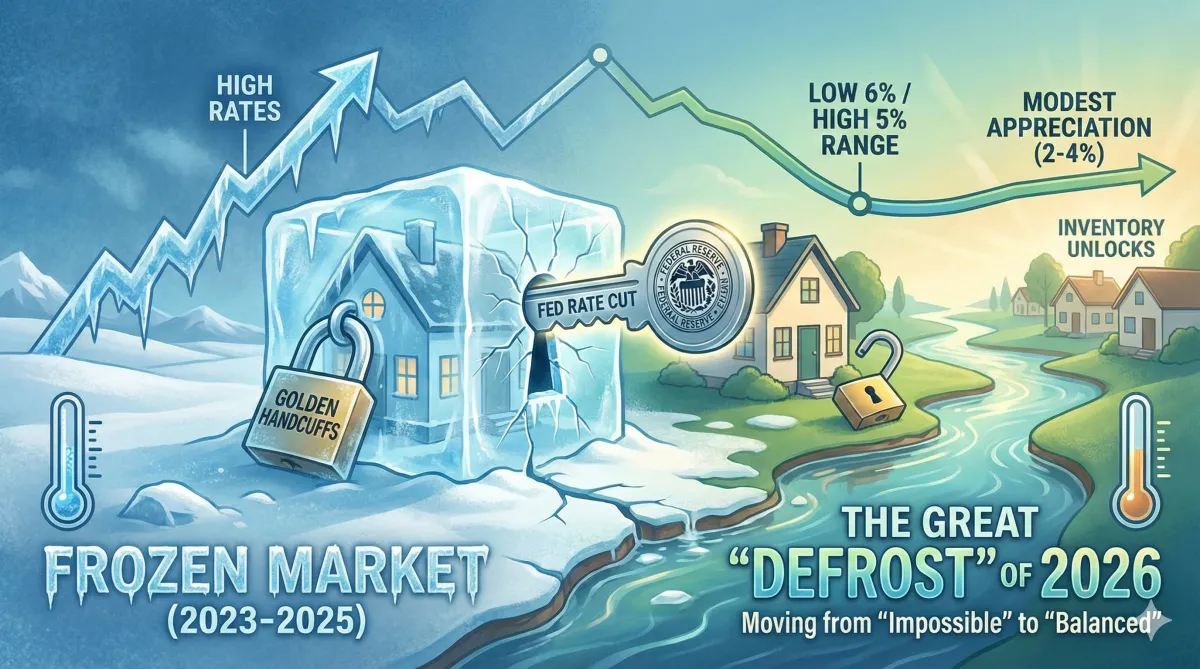
The "Great Real Estate Defrost" of 2026 describes a quick reopening of buyer activity and renewed price momentum after several years of high rates and slow transactions. The catalyst is falling mortgage rates combined with a backlog of buyers who paused plans. This article walks through why the defrost is happening, how different rate paths change monthly payments and qualifying power, and what that means for buyers, sellers, and investors nationally and across California metros. You’ll get clear rate scenarios, numeric examples showing payment and qualifying-income shifts, city-by-city California snapshots, and practical playbooks to prepare for accelerating demand. The sections that follow define the defrost, map likely rate trajectories, present compact EAV-style California forecasts, analyze affordability impacts across buyer cohorts, unpack pent-up demand mechanics, and end with seller and investor checklists. By the end you should have real steps to model outcomes or engage an advisor when the market shifts.
What Is The Great Real Estate Defrost of 2026?

The Great Real Estate Defrost of 2026 is the period when falling rates and easier credit let a backlog of buyers re-enter the market, lifting transactions and putting upward pressure on prices in many areas. The mechanism is straightforward: lower mortgage rates increase purchasing power, turning latent demand into active offers and speeding up sales. Sellers typically see faster time-on-market and stronger negotiating leverage; buyers can either lower their monthly payment or shop higher-quality neighborhoods for the same payment. Knowing how these mechanics work makes it clearer why timing, financing choices, and inventory management will shape outcomes as rates move down.
Three primary drivers power the defrost: rate declines, pent-up demand from rate lock-in, and shifting inventory patterns.
Falling rates restore buying power for rate-sensitive households.
Pent-up demand built up while people postponed moves during high-rate years.
Inventory shifts and migration patterns change local supply dynamics.
Those forces combine to speed absorption of available homes. The next section explains how common market measures — velocity and price trends — usually behave during a defrost.
How will the 2026 housing market change after the freeze?
When the market defrosts, transaction velocity usually jumps: days on market fall, contingent offers increase, and sale-to-list ratios move toward or above parity as demand tightens. Prices often show an initial bump as the most rate-sensitive buyers return, then settle into steadier appreciation as supply responds. That early window favors sellers who time listings to catch the surge. Mechanically, lower rates improve monthly affordability, enlarging the buyer pool and intensifying competition for well-priced homes. Expect short-term volatility while markets reprice, followed by medium-term stabilization as new listings and construction help rebalance supply and demand.
That shift in velocity and pricing ties directly to the policy and macro triggers that start the defrost.
What factors will trigger the real estate defrost in 2026?
The defrost begins when monetary easing, falling inflation, and years of accumulated buying intent converge. Fed easing pushes benchmark yields down, which feeds into lower mortgage rates and improves purchasing power — prompting refinances and purchases. Life-cycle moves delayed by affordability, plus migration and inventory trends, add to the release of suppressed demand. Put together, these elements explain why a rate-driven lift in affordability can trigger outsized transaction responses once a practical affordability threshold is crossed.
Understanding those triggers helps buyers and sellers model rate scenarios — which we cover next.
How Will Real Estate Interest Rates Impact the 2026 Market?
Changes in interest rates will be the main driver of 2026’s market intensity because mortgage rates directly change monthly payments, qualifying amounts, and refinance incentives. In plain terms: a 0.5–1.0 percentage-point drop in mortgage rates meaningfully increases what buyers can afford and can spark a wave of refinances that frees up monthly cashflow. That dynamic helps both owner-occupants and yield-seeking investors move faster as effective financing costs improve. Below are plausible rate scenarios and a compact table to compare affordability effects across different paths.
What are the predicted interest rate trends for 2026?
Analysts typically present two to three plausible 2026 rate paths: a gradual decline, accelerated cuts, and sticky rates with local easing. In a gradual-decline case, modest drops over several quarters steadily boost affordability and sustain a drawn-out recovery. An accelerated-cut scenario brings sharp falls in a short window, compressing time-to-sale and quickly repricing prices as pent-up buyers act. A sticky-rate scenario sees little national movement but local pockets — stronger job markets, housing shortages — still heating up. Key uncertainties are inflation and labor-market strength; those determine both the pace of cuts and lenders’ underwriting responses that affect real-world credit availability.
Those scenario differences feed directly into affordability math and buyer purchasing power under each path.
Historical work suggests nominal mortgage rates matter, but buyer expectations about future appreciation and the real interest rate play a large role in setting housing price levels.
Interest Rates and Housing Price Dynamics: A Historical Analysis
In past episodes (for example, the late 1970s), house prices rose sharply even as nominal mortgage rates climbed. More recently, falling rates have coincided with more measured price moves. This research looks at how expectations of future appreciation can offset the direct effects of nominal interest rates on sale prices. Buyers’ perceptions of real interest rates — not only the headline nominal rate — help explain changes in housing price levels. Because nominal rates don’t immediately reflect shifts in expectations, real rates and appreciation views fluctuate and influence market pricing over time.
The effect of real rates of interest on housing prices, 1989
ScenarioRate ChangeEffect on Affordability / Monthly PaymentGradual Decline-0.5% to -0.75% over 6-9 monthsModerate increase in qualifying power; steady rise in buyer poolAccelerated Cuts-1.0%+ within 3-6 monthsSharp monthly payment reduction; immediate surge in active buyersSticky Rates with Local EasingMinimal national change; local dipsPatchy affordability improvements; uneven market gains
How do interest rates affect homebuyer affordability in 2026?
A 0.5 percentage-point drop on a 30‑year fixed mortgage typically reduces the principal-and-interest payment enough to raise the max home price a buyer can afford at the same payment. Lower rates lower monthly obligations and expand qualifying debt-to-income thresholds, letting many buyers — especially first-time and move-up buyers — bid on higher-priced homes or reduce down-payment pressure. Underwriting can tighten or loosen with macro conditions, but the net result of lower rates is a larger effective buyer pool and more demand for listings. That payment-channel effect is often what turns latent demand into immediate offers.
For personalized mortgage scenario modeling, consider consulting an advisor. Rory The Broker provides mortgage guidance and scenario analysis to help buyers and sellers understand payment and loan-product trade-offs in their market.
What Are California Housing Market Predictions for 2026?

California won’t move as a single block in 2026. Metros with strong job growth and tight supply should see the fastest price and velocity responses, while inland and lower-cost areas will show more mixed affordability gains. Migration flows, job concentration, and zoning constraints determine how much pent-up demand converts into price appreciation locally. The practical takeaway: some Bay Area and coastal metros may re-accelerate quickly, while inland regions may attract buyers seeking affordability. Below are city snapshots in a compact table to make regional differences easy to scan.
Which California cities will see the biggest market shifts?
Likely city/region movers are listed here with the primary driver and the expected 2026 outcome.
City / RegionKey DriverExpected 2026 OutcomeBay Area (San Francisco metro)Tech rehiring and constrained supplyRapid absorption of listings, faster price recoveryLos AngelesEntertainment and diversified jobsSteady demand with selective neighborhood bumpsInland EmpireRelative affordability and commuting trade-offsIncreased buyer interest, moderate price gainsSan DiegoQuality-of-life migration and limited inventoryTight market, faster time-on-marketCentral ValleyAffordability-seeking migrationGradual demand rise, tempered pricing increases
How will California housing affordability evolve in 2026?
Affordability will depend on price-to-income ratios, local wage growth, and any policy steps that change supply or buyer assistance. In many California metros, a modest rate decline only partially offsets already-high price-to-income levels. First-time buyers in costly metros will still face down-payment and qualifying hurdles, while move-up buyers and households relocating from pricier areas may see relative advantage. Local policy — zoning reforms or targeted assistance — can move the needle for entry-level buyers, but without big supply changes, price moves will mainly reflect demand shifts tied to rates. Understanding these local mechanics matters for timing offers and picking loan products that soften initial payment shocks.
If you want deeper city-level reports or tailored timing advice, Rory The Broker offers localized forecasts and lead-capture reports for buyers and sellers across California metros.
How Will Housing Affordability Shape Buyer Demand in 2026?
Affordability in 2026 will re-segment demand: falling rates bring first-time buyers back, repeat buyers weigh equity versus new-rate trade-offs, and investors reassess yields against financing costs. Affordability changes shift budgets and risk appetites across cohorts, which changes who bids and how aggressively. The practical upside for prepared buyers is that modeling different loan types — fixed-rate, ARMs, FHA, conforming — reveals paths to buy sooner with manageable payments. Below we outline the key affordability drivers and contrast strategies for first-time and repeat buyers.
What factors influence housing affordability in 2026?
Affordability will hinge on mortgage rates, wage growth, inventory, underwriting standards, and local policy (zoning or assistance). Rate declines boost purchasing power; income gains improve loan qualification. Tight inventory can eat into rate-driven gains, while new listings or supply-side policy can amplify affordability. Lender behavior — tighter or looser credit — also affects access to lower rates. Track both market rates and underwriting trends to time moves and choose the right product.
Those determinants feed into practical strategies for different buyer groups below.
How will affordability affect first-time and repeat buyers?
First-time buyers benefit most from net affordability improvements but still face down-payment and closing-cost barriers; programs and low-down-payment options (FHA, conventional with assistance) can enable entry even when prices are high. Repeat buyers must decide whether to tap equity for a down payment or keep their current rate — modeling blended mortgage costs and the break-even point is essential. Investors and trade-up buyers should align hold-period expectations with financing: fixed rates stabilize cashflow, ARMs can improve near-term affordability but add rate risk. Tactics like bridge loans, mortgage porting, or staged down-payments can ease transitions for both cohorts.
Many buyers find mortgage scenario modeling helpful; Rory The Broker provides guidance on loan products and timing around rate paths.
What Role Does Pent-Up Buyer Demand Play in the 2026 Real Estate Defrost?
Pent-up demand is the pool of households that delayed moves because of high rates, thin inventory, or uncertainty. When affordability improves, that latent demand releases and amplifies transaction velocity. The mechanism is both behavioral and financial: people delayed purchases, saved more, or shifted plans during the freeze, and relatively small improvements in rates or local conditions can prompt action. Markets with larger built-up demand will see sharper absorption and possible short-term price spikes as the backlog clears; markets with less pent-up intent will have gentler recoveries. Knowing who makes up that backlog helps gauge pace and depth of the defrost locally.
Research Spotlight: The Mortgage Rate Lock-In Effect and Inventory
A significant contributor to pent-up demand and constrained inventory in recent years has been the "mortgage rate lock-in effect." This phenomenon occurs when homeowners, having secured historically low mortgage rates (e.g., below 4-5%) in previous years, become reluctant to sell their current homes. Moving would mean trading their low-rate mortgage for a new one at a significantly higher rate, leading to a substantial increase in monthly payments for the same or even a lower-priced home.
Economic studies and market analyses consistently show that this lock-in effect has suppressed housing supply, as potential sellers choose to stay put rather than incur higher financing costs. However, as mortgage rates continue their downward trend, particularly if they stabilize in the low 6% to high 5% range, the disincentive to sell diminishes. This narrowing gap between existing low rates and new market rates is projected to unlock a substantial wave of inventory, as more homeowners find it financially viable to make their long-delayed moves, further fueling the "Great Real Estate Defrost."
Source: Various economic research papers on housing market dynamics and mortgage rate sensitivity, 2022-2024.
Next we look at how that backlog formed and which buyer types will be most active.
How has buyer demand accumulated before 2026?
Demand piled up through delayed lifecycle moves (marriage, downsizing, upsizing), rate lock-in where homeowners stayed put to keep low mortgages, and extra saving by some households. Economic uncertainty and high housing costs in prior years pushed many to postpone purchases, creating a multi-year pipeline of intent. When affordability improves even a bit, previously dormant buyers can re-enter quickly if personal circumstances (job change, family growth) align.
Understanding that backlog helps rank which buyer types will move fastest.
What types of buyers will drive the 2026 market surge?
The surge will likely be driven by first-time buyers reactivated by improved affordability, trade-up buyers using built-up equity, relocating households seeking better value, and selective investors chasing yield. First-time buyers respond when mortgage payments approach or undercut comparable rents. Trade-up buyers use equity to bridge down payments. Relocators and remote-work migrants chase quality-of-life or job opportunities, and investors focus on markets where appreciation and rental yields line up with financing. Those cohorts together determine the scale and distribution of the defrost — with first-time and relocating buyers often producing the earliest lift in listings-to-contracts ratios.
These cohort dynamics lead into tactical steps sellers and investors should take to capture gains during the defrost.

How Can Sellers and Investors Prepare for the 2026 Housing Market?
Sellers and investors should take proactive steps on pricing, marketing, financing, and risk management to capture value as the market accelerates. Preparation ranges from staging and competitive pricing to modeling financing alternatives and setting clear hold-versus-sell rules. Timing and execution drive returns: sellers who list as buyer momentum builds often get stronger offers, while investors who match leverage and exit strategies to market conditions can benefit from appreciation and rental demand. Below is a compact strategy table and practical checklists you can use to act with confidence.
Use these tactics to align your approach with your risk tolerance and goals.
StrategyUse CaseExpected ROI / RiskPrice Aggressive ListingCapture early surge and multiple offersHigh ROI if inventory tight; risk of overpricing if market coolsStaging & Minor RenovationImprove perceived value and reduce days on marketModerate ROI; low execution risk for common upgradesHold & RefinanceInvestors using lower rates to improve cashflowBetter yield with lower rates; risk if rents or rates shift unfavorablyBuy-and-Hold Value-AddLong-term appreciation and rental incomeHigher ROI over multi-year horizon; requires capital and active management
The table above helps match strategies to timing and goals. Below are operational checklists to implement these approaches.
Sellers can follow this playbook to maximize outcomes during the defrost:
Price Competitively: Set a listing price to draw early interest and encourage multiple bids.
Invest in High-ROI Improvements: Focus on curb appeal and kitchen/bath updates that move the needle.
Stage and Market for Speed: Professional staging and photography shorten time-on-market.
Plan Negotiation Strategy: Prepare inspection and contingency timelines that keep offers competitive while protecting your position.
Investors should apply disciplined criteria to capture opportunities:
Assess Financing Options: Compare fixed-rate mortgages, bridge loans, and other products against your hold period.
Prioritize Cashflow and Cap Rate: Model rents, financing costs, and vacancy to validate returns.
Select Markets with Demand Tailwinds: Target metros with rental growth or constrained supply.
Define Exit Strategies: Set hold thresholds and renovation timelines to limit market-timing risk.
Short service note: Rory The Broker can help sellers and investors with pricing strategy, staging referrals, and mortgage/cashflow analysis to model scenarios and match financing to intended hold periods. This brief mention connects readers to resources while keeping the focus on tactical guidance.
This concludes the article content under the provided headings.
Frequently Asked Questions
What should buyers consider when entering the 2026 housing market?
Buyers should track interest-rate trends, confirm financial readiness, and study local market signals. Small rate moves can change affordability meaningfully, so monitor rates and get pre-approved to know your budget. Think about your time horizon — how long you’ll stay — and whether you need flexibility. A local, experienced advisor can provide tailored advice and help you act when the window opens.
How can sellers effectively price their homes in 2026?
Sellers should price based on recent comps, current demand, and expected buyer mix. A competitive price draws attention quickly in a fast market; staging and minor, targeted upgrades improve perceived value. Work with a real estate pro to balance an aggressive price that attracts offers with a strategy that protects you if the market shifts.
What role do local economic conditions play in the housing market?
Local economies matter a lot. Job growth, wage gains, and migration patterns drive demand and prices. Strong employment markets typically see quicker sales and stronger pricing; areas in economic decline often face weaker demand. Understanding your local job market and population trends helps you predict which neighborhoods will move first during the defrost.
How can first-time buyers navigate the 2026 housing market?
First-time buyers should focus on affordability and available assistance programs. Learn the mortgage options — low-down-payment programs, FHA, conventional with assistance — and get pre-approved to clarify your buying range. Work with an agent who knows first-time buyer resources and can find homes that meet your needs and budget.
What strategies can investors use to capitalize on the 2026 market?
Investors should look for properties in high-demand areas with strong rental fundamentals. Do deep market analysis — rents, vacancy, job growth — and stress-test financing scenarios. Diversify by property type or geography if possible, and pick financing that matches your planned hold period to manage cashflow and risk.
How will changes in buyer demographics affect the housing market?
Demographic shifts will shape demand in 2026. Younger buyers often prefer walkable, amenity-rich neighborhoods and value affordability; older buyers may seek downsized or accessible homes. These preferences will influence which property types and neighborhoods outperform. Developers and sellers who match product to changing buyer needs will have an advantage.
Conclusion
The 2026 housing outlook centers on lower rates unlocking a backlog of buyers. By understanding affordability mechanics, regional differences, and buyer behavior, buyers and sellers can time moves and choose financing to protect outcomes. Work with a knowledgeable real estate advisor to translate these insights into a plan tailored to your situation. Explore our resources and contact Rory The Broker for personalized forecasts and mortgage scenario help to stay ready when the market shifts.


